

The Wasteland-turned-Nirvana: a Tour of Lincoln’s Inn Fields
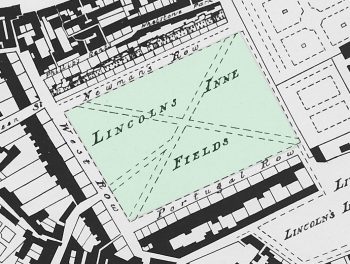
Join actors, musicians and Dr Matthew Green for an immersive whirlwind tour of London’s largest and most fascinating square, Lincoln’s Inn Fields, in all its stately, windswept glory, beginning with a visit to Sir John Soane’s Museum, one of the most exquisitely preserved Georgian townhouses in London, containing Hogarth originals.
- Each ticket includes a complimentary signed copy of Matthew’s new, critically-acclaimed book, Shadowlands: A Journey through Lost Britain (Faber), to be mailed when the paperback is released on 6 April, or handed over on the tour.
Experience how two ‘waste common fields’ where students jousted and traitors , from the 1630s, into a parade of brick-built houses for the cream of Stuart and Georgian society, yet with its vast inner space ‘forever open and unbuilt’, its riddled doxies, crooked link-boys and fake beggars a foil to those who swirled about them in sedan chairs.
As daffodils shoot through the grass, weave through the square’s ancient gardens, forlorn execution sites and historic trees with costumed actors planted en route, ready to leap out, allowing you to hear William Hogarth‘s story first hand, and marvel at the splendour of Lincoln’s Inn’s assemblage of striking historic buildings.
See the sole-surviving original house, built by Inigo Jones in 1640, perhaps the oldest shop in England from 1657, Sir Charles Barry’s Royal College of Surgeons (1835), the labyrinthine turnstile streets which once prevented livestock darting out, and the fictional address of Bleak House’s sinister lawyer, Mr Tulkinghorn, where lawyers lay ‘in shrunken fragments of greatness…like maggots in nuts’, the Seven Stars, and the extraordinary Marshall Building, jewel in the crown of the LSE.
Feel how these peculiar and unsettling juxtapositions somehow linger in the air like residual smoke from its sea coal-smeared terraces. Discover how this extraordinary quadrangle, along with its sister squares further west, precipitated the West End revolution, replacing tumbledown Tudor sprawls with elegant neo-classical terraces, making the urban urbane for the first time since the classical era.


